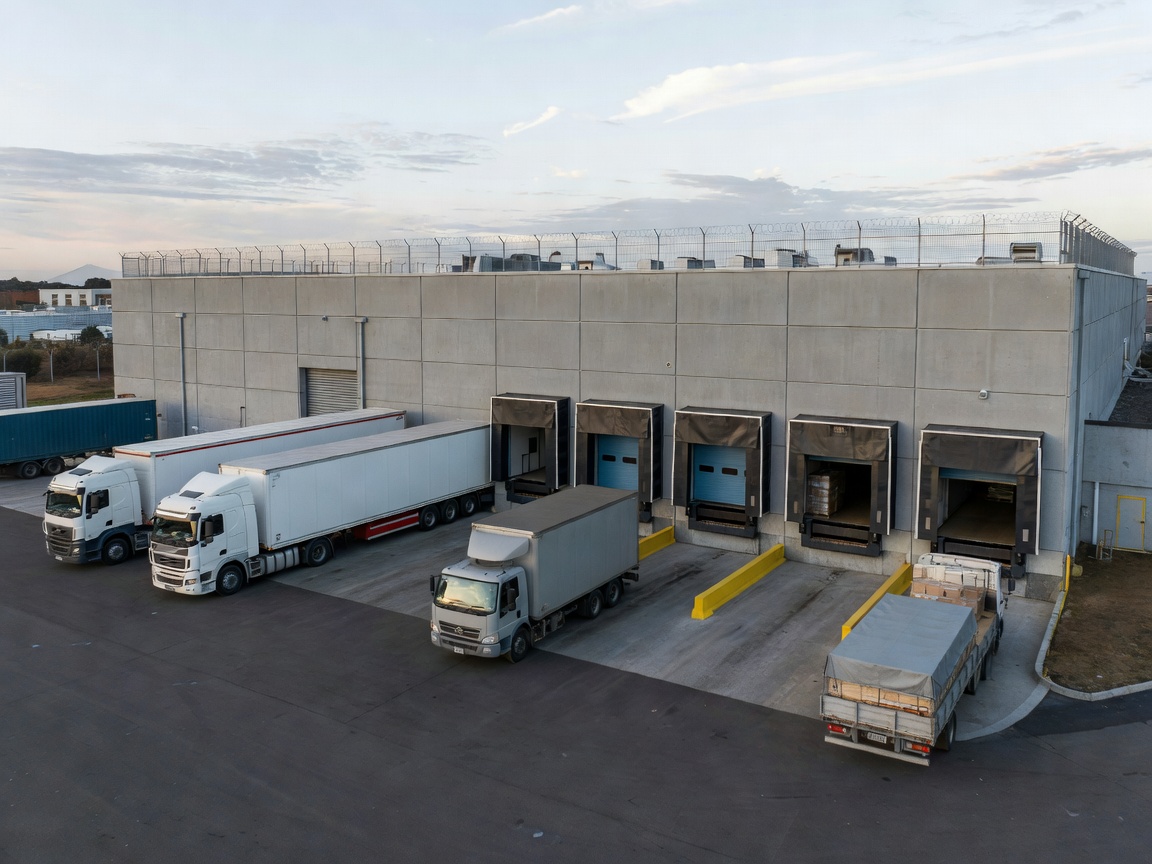
Distribution centres and regional warehouses
A distribution centre receives goods, holds or processes inventory and releases cargo to downstream destinations. A regional warehouse may serve a defined territory, product range or operational purpose. The facility’s role should be explicit: reserve storage, rapid transfer, order assembly, returns handling or a combination of tasks.
Location links inventory decisions to transport. A site closer to demand may support shorter outbound legs, while a more central position may serve several directions. Neither is automatically better. Consider where goods originate, where orders arise, how replenishment reaches the site, what transport modes connect and what operational constraints apply.
Confirm the facility’s handling scope and terms directly. Do not infer capacity, equipment, opening hours or current availability from a building image or a generic facility description. Requirements may include product compatibility, packaging, pallet or unit standards, data exchange, stock control and site access.
Cross-docking and order consolidation
Cross-docking moves inbound goods through a facility toward outbound movement with limited or no planned storage. It can suit flows where inbound and outbound plans are coordinated, cargo is identified correctly and destination sorting can happen without creating a queue. It is not simply warehouse storage performed faster. Timing, data accuracy, staging space and exception handling are central.
Order consolidation combines items or shipments into a planned outbound movement. It can reduce fragmented dispatches, but it creates pick, sort, verification and load-sequencing tasks. The process needs clear order cut-offs, inventory visibility, destination rules and a method for handling missing or damaged items.
Traditional storage provides a buffer between inbound supply and demand. It supports inventory positioning but uses space and requires receiving, put-away, replenishment, count control and release processes. Choose a model based on demand patterns and product needs rather than assuming a single design serves every cargo flow.
Inventory positioning and inbound planning
Inventory placement determines which locations hold which items and in what quantities. A useful design balances replenishment effort, service area, product characteristics, stock risk and transport options. In a Nordic network, distances, coastlines, cross-border movements and access to transport corridors can affect replenishment choices. Those factors should be mapped rather than reduced to a single central location.
Inbound plans need to connect upstream gateways with warehouse receipt. A port, airport or rail terminal may feed a distribution centre through road transport or a multimodal chain. Confirm cargo release, load compatibility, appointment process, shipment references and receiving instructions. A missed or incomplete handoff can affect stock visibility even when goods are physically nearby.
Separate planned inventory from goods in transit and goods awaiting checks. Agree which event updates inventory status, who resolves a mismatch and how damaged or unexpected cargo is isolated. Accurate status supports better outbound decisions.
Outbound transport and final-mile interfaces
Outbound dispatch translates orders into loads, routes and delivery sequences. Consider vehicle suitability, order grouping, delivery constraints, collection process, proof-of-delivery information and how exceptions return to the facility. Road transport often provides the connection to dispersed delivery points, but route suitability depends on cargo, access and operating arrangements.
Final-mile interfaces can include a store, industrial receiver, local depot, construction site or another network node. Confirm unloading needs, receiving access, contact procedures and any handling restrictions before dispatch. The facility’s own release capability does not guarantee that the receiver can accept a load at a particular time.
Reverse flows matter too. Returns, reusable packaging, rejected deliveries and repair or inspection items need a designated path into inventory or a separate control area. Define how they are identified and whether they can re-enter sellable or usable stock.
Location trade-offs
| Location factor | Potential benefit | Planning trade-off |
|---|---|---|
| Near demand | Closer outbound connection to part of the service area | May complicate inbound replenishment or coverage elsewhere |
| Near a gateway | Direct interface with inbound cargo flows | May not suit the distribution footprint or demand pattern |
| Central corridor | Access to multiple directions or transfer options | Centrality on a map does not prove route or service suitability |
| Multiple regional sites | Inventory can be positioned closer to distinct demand areas | More stock control, replenishment and coordination points |
Use actual origin-destination patterns and confirmed access information when comparing locations. The table describes considerations, not guaranteed results.
Advantages, limitations and operating checklist
A well-defined distribution network can organize storage, order processing and outbound movement around a service area. Its limitations include inventory carrying requirements, facility handling constraints, additional transfers and the need to maintain reliable stock data. Cross-docking may reduce planned storage but demands tighter coordination; multi-site positioning may improve regional reach but increases control complexity.
- Define each facility’s role, cargo acceptance and handling requirements.
- Map inbound gateways, replenishment routes, transfer events and receipt controls.
- Compare centralized, regional and cross-dock arrangements against demand geography.
- Set inventory ownership, status, count and exception processes.
- Confirm outbound vehicle, receiver access and final-mile requirements.
- Plan reverse flows, failed delivery returns and damaged cargo segregation.
Key considerations
Facility location is a network choice, not a standalone property decision. It changes where inventory sits, how often cargo transfers and which transport legs become necessary. Evaluate inbound replenishment and outbound delivery together. Confirm facility capabilities directly, model operational dependencies, and keep stock status aligned with physical movement.